December 25, 2019

The Gift

The Gospel of John, Chapter One
In the beginning was the Word, and the Word was with God, and the Word was God. He was in the beginning with God. All things were made through Him, and without Him nothing was made that was made. In Him was life, and the life was the light of men. And the light shines in the darkness, and the darkness did not comprehend it. . .He was in the world, and the world was made through Him, and the world did not know Him. He came to His own, and His own did not receive Him. But as many as received Him, to them He gave the right to become children of God, to those who believe in His name: who were born, not of blood, nor of the will of the flesh, nor of the will of man, but of God.
And the Word became flesh and dwelt among us, and we beheld His glory, the glory as of the only begotten of the Father, full of grace and truth.

The empty tomb, Jerusalem, Israel

Why a photograph of a tomb instead of a baby in a manger? Because, although Christmas was the beginning, this tomb -- this empty tomb -- was always the destination, the validation of Jesus' life and sacrifice.

First Corinthians, Chapter Fifteen
Moreover, brethren, I declare to you the gospel which I preached to you, which also you received and in which you stand, by which also you are saved, if you hold fast that word which I preached to you—unless you believed in vain.
For I delivered to you first of all that which I also received: that Christ died for our sins according to the Scriptures, and that He was buried, and that He rose again the third day according to the Scriptures, and that He was seen by Cephas, then by the twelve. After that He was seen by over five hundred brethren at once.
 
The gift of God is eternal life, available to all and received by simple faith in Jesus Christ, who died to bear the penalty for all my sins and all of yours, was buried, and rose victorious over death and the grave.

December 22, 2019

The Fascination of Foreign Faces: Part III

The young scholar, Mayalan Village, Northern Guatemala


Fourth, be invisible.  This isn't a contradiction; it simply means working without calling unnecessary attention to yourself.  In crowds I practice invisiblity by avoiding direct eye contact.  That doesn't mean I avoid looking at people, but rather that I seem to look through and beyond them.  Locking eyes with individuals can cause them to feel singled out or threatened -- not a good thing in countries where political/cultural factors make it wise for most citizens to keep a low profile.  When  photographing people in this way I sometimes take the camera away from my eye after making the picture and continue to look toward but past the subject.  Very often he'll look around to see who or what I was photographing.

Another kind of invisibility occurs when you work in an open, straightforward, and businesslike way.  People will watch you carefully for signs of indecisiveness or fear.  When you project the attitude that you have a right to be there because you have a legitimate, worthwhile job to do, most people will relax and allow you to get on with your photography.  People in other countries are usually gracious, hospitable, and patient with strangers who observe the basic courtesies.

Fifth, be occupied.  Actually, this refers to the subject rather than you.  Often, the best time to photograph is when your subject is involved in an activity.  A parade, a fiesta, a sporting event, religious ceremonies, work, or play...whenever the subject is more interested in something else than he is in you, the time is right for good pictures.

I photograph frequently in classroom and worship situations where the people are fully aware of my presence.  What's more, against all the advice I've heard or read, I often do it with multiple flash.  Whenever possible, I have the person in charge introduce me and explain why I'm there.  Then I ask the people to continue with whatever they were doing as if I were not there.  I work slowly at first, while they check me out with sidelong glances; but they become used to my presence much more quickly than you would imagine and are once again fully involved in their activity, yet with an awareness which produces a kind of hyper-intentness and concentration.  I almost always get pictures with heightened emotional and dramatic impact in such situations.

Shopkeeper, Madras, India

Even more than making photographs of people engrossed in activity, I like to make portraits of them looking into the camera.  I want to look, and help others look through  their eyes and into their souls.  To make a personal connection with them through my photography.

It isn't difficult to make great portraits of people in most foreign environments,
but there aren't many people doing it.  The principles in this article have been tested
around the world and they will work for you if you will use them.  You can learn to relate
to people and make portraits which will express their dignity and humanity and at the
same time express and satisfy something deep within yourself.

Foreign faces are endlessly fascinating, because they are the faces of our family.

December 20, 2019

The Fascination of Foreign Faces: Part II

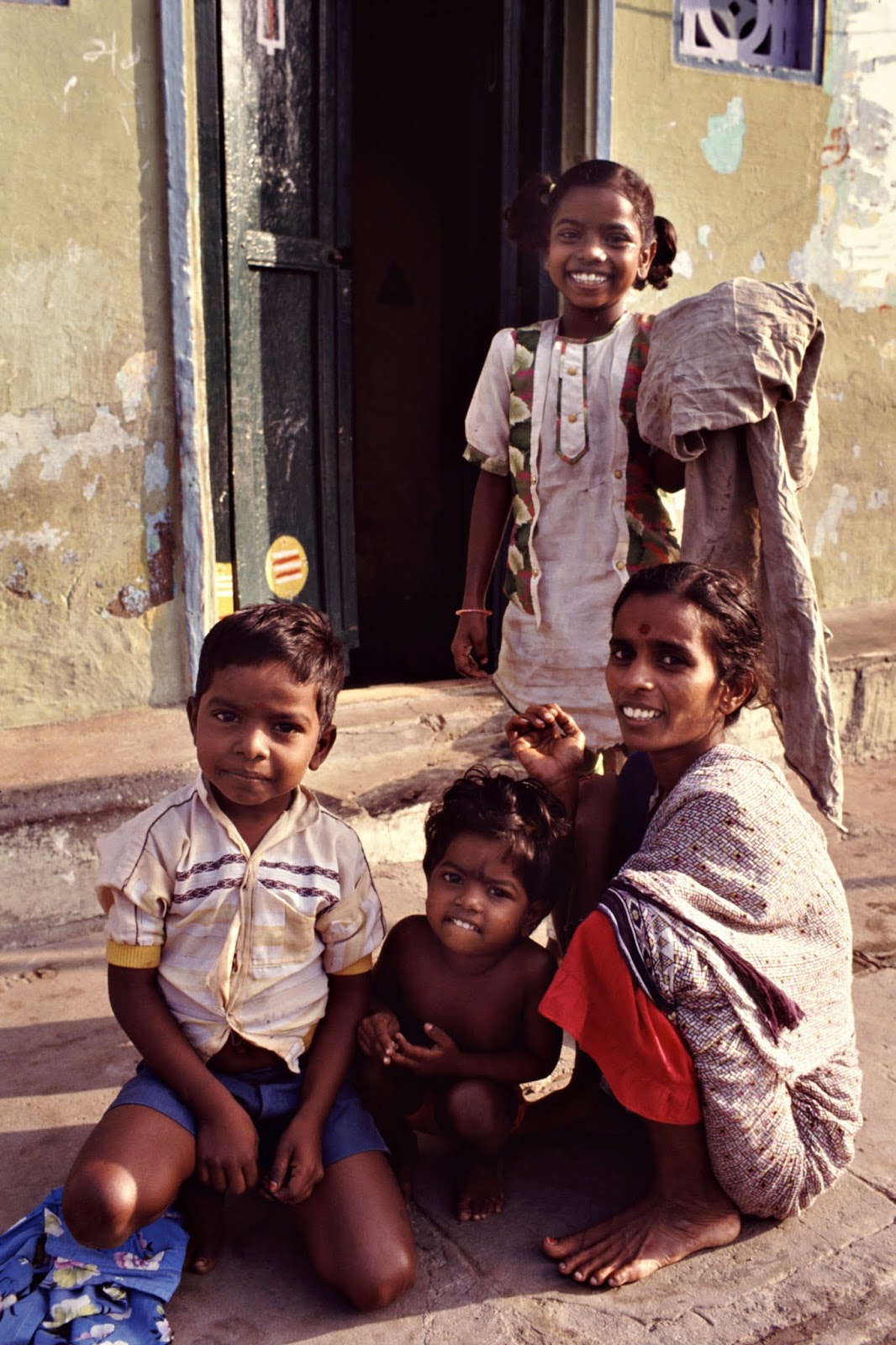
Fisherman's Family, Madras, India


So how does one go about making good pictures of people in foreign settings?  It isn't hard if you're prepared.  Here are some basic principles of people photography which have worked as well for me in African villages as on the streets of London.

First, be organized.  Know what you want to accomplish and plan how you're going to do it.  Make decisions about cameras, lenses, and films before leaving home.  Become so familiar with your equipment that you can use it almost without thinking.  Aging eyes and general laziness make zoom lenses on Canon EOS bodies my mainstay these days, but some of my best people photos were made with Olympus OM bodies and prime lenses in 24, 35, 85, and 180mm focal lengths.

My camera bag stays at the hotel, while two bodies with (nowadays) 24-85 and 70-200 lenses go over my shoulders.  Film, caption notebook, passport, local currency, and a few U.S. one-dollar bills go in a small belt pouch.  I'm light, mobile, and organized to give full attention to the subject.
           
It's also essential to be organized in the way you go about making photographs once you have some kind of entree with a subject.  People in other countries are can be amazingly gracious and patient, but it's an imposition to ask them to stand for several minutes while you work them over with a spot meter and make multiple lens changes.  Both common courtesy and good photographic practice dictate that you decide about exposure, angles, and focal lengths before approaching the subject, and then make your photographs in a friendly, businesslike manner.  Before I spoke to the young craftswoman I had already decided which lenses would be needed, mounted them on my cameras, and read the light with an incident meter.  I was ready to work quickly, fluidly, and with a confidence that communicated itself to my subject, helping her to be more at ease and responsive.
           
Second, be obvious.  An American with a camera in a Guatemalan village marketplace is conspicuous.  There's nothing you can do to change that.  Everyone knows you're there, so don't try to sneak shots.  They're probably more curious about you than you are about them.  If you try to hide in the shadows and pick off shots with a long lens, if you're furtive, if you appear indecisive or uncertain, you'll be greeted with suspicion.  Accept the fact that you're not going to get fly-on-the-wall candids and go with the flow.  Concentrate on what you can get.  Because if you treat those people with courtesy and friendliness, chances are you'll be able to make both excellent photographs and new friends at the same time.  The key is simply to be natural.  Behave as if you have a perfect right to be there and go about your work in a pleasant, matter-of-fact way.

Coffee Plantation Worker with His Pet Rabbit, Costa Rica

Third, be open.  Fear is the number one hindrance to good people photography.  For that matter, fear of being open and vulnerable is the greatest hindrance in most human relationships.  Fear often comes in the form of an inertia which suggests all kinds of reasons why you shouldn't take the picture now.  Later will be better.  The light will be better.  The people will be more receptive.  You don't have the right lens.  Or the right film.  Later...but not now.  If you want to make good photographs of people, you must put aside your fear and inertia by an act of your will and begin to photograph -- now.  Not later -- now! 

What does this have to do with being open?  Everything, because people will not open up to you until you open yourself up to them.  Put aside your fear of photographing them openly.  Project sincere attitudes of  friendliness and courtesy.  Don't talk any more than necessary.  A smile will open more doors than words any day.  These are not aliens from another galaxy -- they're people, and they will respond to your efforts to relate to them as people.  A smile, an eyebrow raised in question, a tilt of the camera, a word of greeting in the local language (if you haven't bothered to learn the words for "hello," "please," and "thank you" in their language you shouldn't even be there) will usually gain the cooperation you need.  If not, just smile, say "thank you," and move on.  My few words of Tamil spoken to the young woman nearly exhausted my meager vocabulary, but when combined with an open,  friendly approach they were enough to do the job.

(To be continued)

December 18, 2019

The Fascination of Foreign Faces


Images for Sale. Madras, India


"Wannakil" --"hello," I said with a smile, right hand in front of my face with fingers up, palm slightly out in the South Indian gesture of casual greeting.
"Wannakil," replied the attractive young Indian woman, continuing to paint intricate details on a small plaster Hindu temple for her sidewalk statuary stall.  Her husband and small child watched the tall, bearded foreigner with friendly interest from a nearby tent.

Still smiling and with a question in my eyes, I tilted my camera slightly.  With a pleased smile, she nodded as I gestured to indicate that she should go on with her work.  As she did, I began my work also, making exposures from several different angles, then changing to a second camera body with a wider lens for a few more frames.

The Image Painter. Madras, India

 "Nandri" -- "thank you," I said with a repeat of the salute-type gesture.  She responded in kind, we both smiled, and I moved on down the street in search of other opportunities to make brief but no less genuine personal contacts with the people of India.

As a photojournalist and producer creating magazine features and audio-visual programs to help religious and humanitarian agencies communicate their mission, I'm always looking for opportunities to make portraits.  Strong photographs of people add power to the message I want to communicate, because people are interested in people.  That's why we call it "human interest."  When someone from another culture is portrayed in all of his or her humanity, dignity, and individuality, both the subject and those who view the photograph are served.  As the great Edward Steichen, creator of the landmark "Family of Man" exhibit said, "The function of photography is to explain man to man."

Mayan Tribesman. Northern Guatemala

Photography bypasses the logical centers of the brain and communicates directly to the heart.  When the subject is someone from another culture, an incisive portrait can arouse in the viewer a deep awareness that this also is a person, a member of my species.  Different from me, yes, but part of my family.  Nearly 30 years have passed, but I still remember the first time a photograph connected with me in this way.  It was an Emil Schultheiss portrait of an African girl in the old Modern Photography magazine.  Her face plastered with ceremonial paint, she peeked at the camera from the corners of her eyes.  I looked into her soul and was hooked for good.

(To be continued.  This article was first published in Rangefinder Magazine.)
(All photos with Olympus OM cameras and lenses, Fujichrome 100 film.)