March 17, 2021

Reposting:: Eastern Europe 1990: Bulgaria

Sofia, Bulgaria from our hotel balcony


Blog Note: I had hoped to make each of these posts correspond to the actual day in 1990, but as I said before, there is just too much to tell to limit each country to a single post; especially if we were there for several days.

We were met at the Sofia, Bulgaria airport on Monday, March 12 by Church of God National Overseer Pavel Ignatov and several of his associates, including Peter, his interpreter, and taken to the Park Hotel Moskva. Louise took the afternoon off to catch up on her rest and I hit the streets of Sofia with my cameras.

Downtown Sofia
A mix of the modern and the ancient.
Sofians enjoy a warm day in March.

That evening we were joined by the Rev. Paul Lauster from Berlin, the Eastern European Director for the Church of God, and taken to a mass rally in a rented movie theater -- the first time ever for all the Churches of God in Sofia to assemble in one place. It was standing room only, with packed balconies, stairs, and the lobby, with more standing outside. It was a joyous, enthusiastic group, estimated at 800-1000 people.


The all-city Church of God assembly.
The first in history for Bulgaria.
A worshipper at the rally.

After the rally we were taken to a nice restaurant on the mountain outside Sofia and entertained with live folk music by a foursome that featured a gypsy violinist.

 
Those Bulgarians fortunate enough to own cars keep their
windshield wipers locked inside except when it's raining.
Sometimes, though, the thieves even steal headlights.
The meat display shelves in Sofia's largest supermarket.
Under Socialism, everyone is equal. No one has anything.

We were in Sofia most of the next day, then set off in late afternoon for a church in a small town east of Sofia, arriving just before dark. After a 45-minute service, and with all kinds of food pushed into our hands by the hospitable villagers, we set off at high speed through the dark to another service at another small village church. Another brief service, then another high-speed drive to still another small church.

Pavel Ignatov and Paul Lauster pray over a young man
with cerebral palsy at one of the rural churches.

I should mention that we were traveling in a pair of Ladas, which were FIATS made in Russia under license from the Italians. One was driven by Pavel and the other by his brother. With four of us in each car we were fairly comfortable except for the fact that Pavel and Ronan drove at a steady 160 kph (that's about 100 miles per hour, if you don't know your metrics), over roads most of us would hesitate to tackle at half that speed. Not to mention that it was a very dark night.

Suddenly, Pavel slammed on the brakes. Being both a fatalist and a believer in the sovereignty of God (a potent combination!), I was asleep, so I missed the sight of the large wild boar who briefly challenged us for possession of the road. Fortunately, he thought better of it in time to save us all some bother.

After the third service of the evening there was another reckless, breathless, 60-mile ride to the city of Shumen, where we checked into a fairly new government hotel for the night.

All photographs were made with Olympus OM and Leica M cameras and lenses, plus a 100-300mm f4 Tokina lens in Olympus mount. Films were Fujichrome 100D and 400. Photographs copyright 2021, David B.Jenkins

I post Monday, Wednesday, and Friday each week.

Soli Gloria Deo

For the glory of God alone

Tags: Dave Jenkins, David B. Jenkins, film photography, Eastern Europe, Bulgaria, Sofia, Church of God, Lada automobile, Olympus OM cameras, Leica M cameras, Fujichrome film.
March 15, 2021

Re-post: Eastern Europe 1990: Yugoslavia

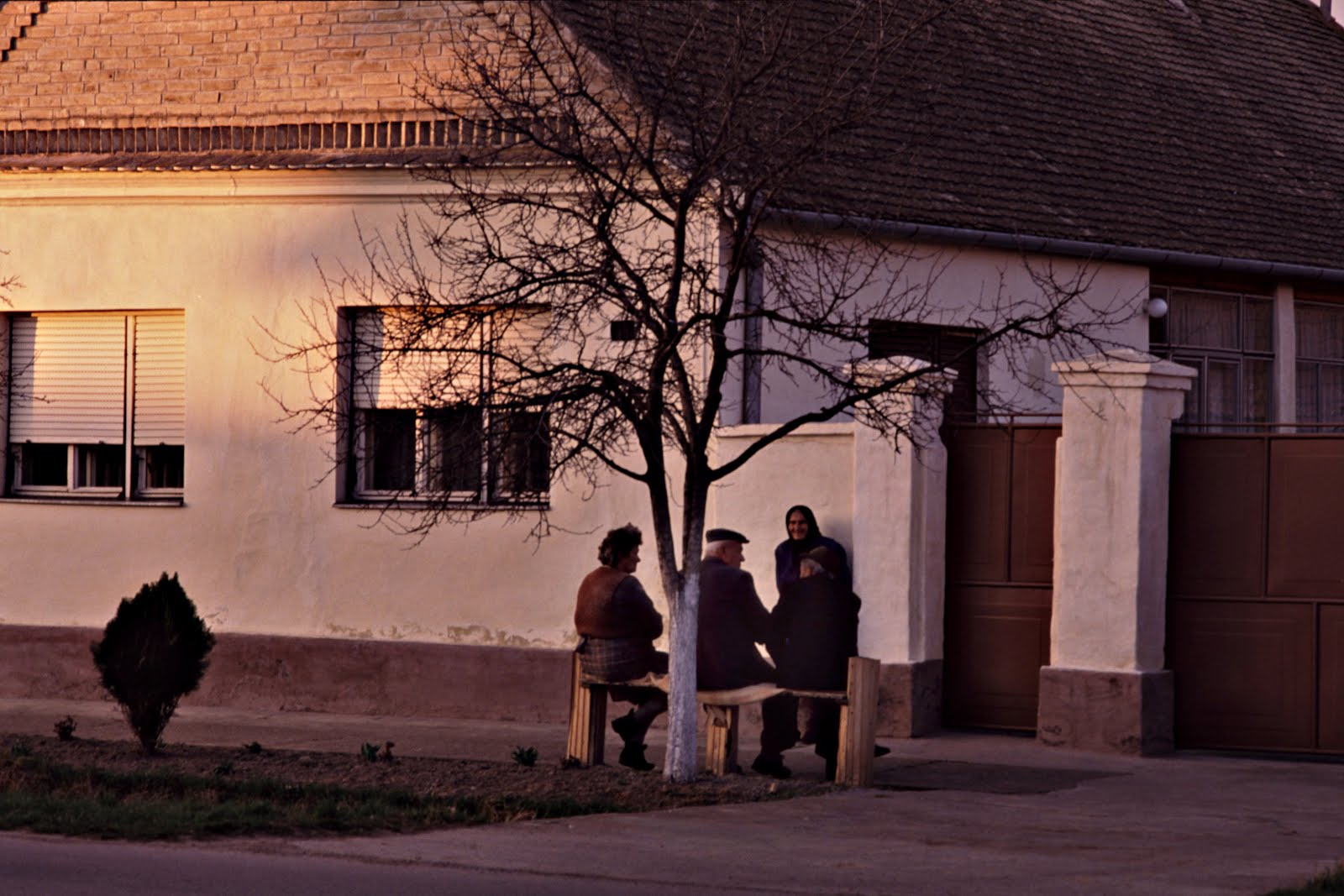
Villagers at Dalj on the Danube River
enjoy the evening light.
(Click to enlarge)
 
 
Surviving, somewhat to our surprise, the Flight of the Dirty Birdie (also known as a shabby and dirty Yugoslav Airlines two-engine propeller-driven puddle-jumper), we arrived from Berlin to Beograd in what is now Serbia on the morning of March 10, 1990 in need of a bath but otherwise little the worse for wear.

We were kept on the move for our two days in Yugoslavia; visiting churches in cities such as Sremska Mitrovica, now in Serbia, Vincovci, now in Croatia, and Dalj, a lovely village on the Danube River, also in Croatia. Under Communism,Yugoslavia was all one country; now it has broken up into seven separate nations. It was a bit confusing to try to retrace our tour of 30 years ago, but Google Maps is our friend!

One of the small Church of God
congregations in Yugoslavia.

The Pentecostal movement, of which the Church of God is a part, came to Yugoslavia in 1925 when a Yugoslav man became an evangelical Christian while living in America. He returned to his home country and began starting independent Pentecostal churches. In 1968, one group of them united with the Church of God.

Under the repression of the Marxist government, the congregations remained small and struggling, numbering only 25 by 1990. Evangelical and Pentecostal churches in Communist countries struggled against unbelievable odds because they refused to be licensed by the government, which essentially would have meant allowing the government to run their churches. 

The Yugoslav believers are fervent in spirit.

Although the Berlin Wall was probably the most visible portion of the Iron Curtain within which the Marxist governments kept their peoples captured, their greatest effort was to build an even more impregnable wall around the minds of their captives: a wall to keep the Word of God out and the darkness in.

That's why Communism's greatest persecution has always been directed against religion. They have sought zealously to drive out the Word of God and replace it with the atheistic religion of Marxism.

Most of the Yugoslav Christians are
working people and not well-to-do.

On the surface, they were successful. By 1988, it is estimated there were only about 250,000 bibles in the entire Soviet Union. There were no Bible story books for the kids, no Sunday School literature, few schools to train young people for Christian service; in fact, in many of the Iron Curtain countries it was against the law to teach the Christian religion to children under 18.

Finding the promises of Communism to be empty,
many young people are turning to Christianity.

Conditions for Christians in Yugoslavia were not as bad as in some of the other Iron Curtain countries, because there was some limited religious liberty. Life was still a struggle for believers; yet in place after place as we traveled around the country we found small groups of fervent, enthusiastic believers who were not daunted by the odds against them. And everywhere we went we were welcomed with great  warmth and hospitality.


A barge on the Danube near Dalj.

(Photographs made with Olympus OM and Leica M cameras and lenses, Fujichrome 100D and 400D films.) 
  
Photographs copyright 2021, David B.Jenkins

I post Monday, Wednesday, and Friday each week.

Soli Gloria Deo

For the glory of God alone

Tags: photography, Dave Jenkins, Church of God, Beograd, Serbia, Croatia, Danube, Olympus OM, Leica, Fujichrome, Yugoslavia, Yugoslav Airlines

March 12, 2021

Re-post: Eastern Europe 1990: East Berlin and the Wall

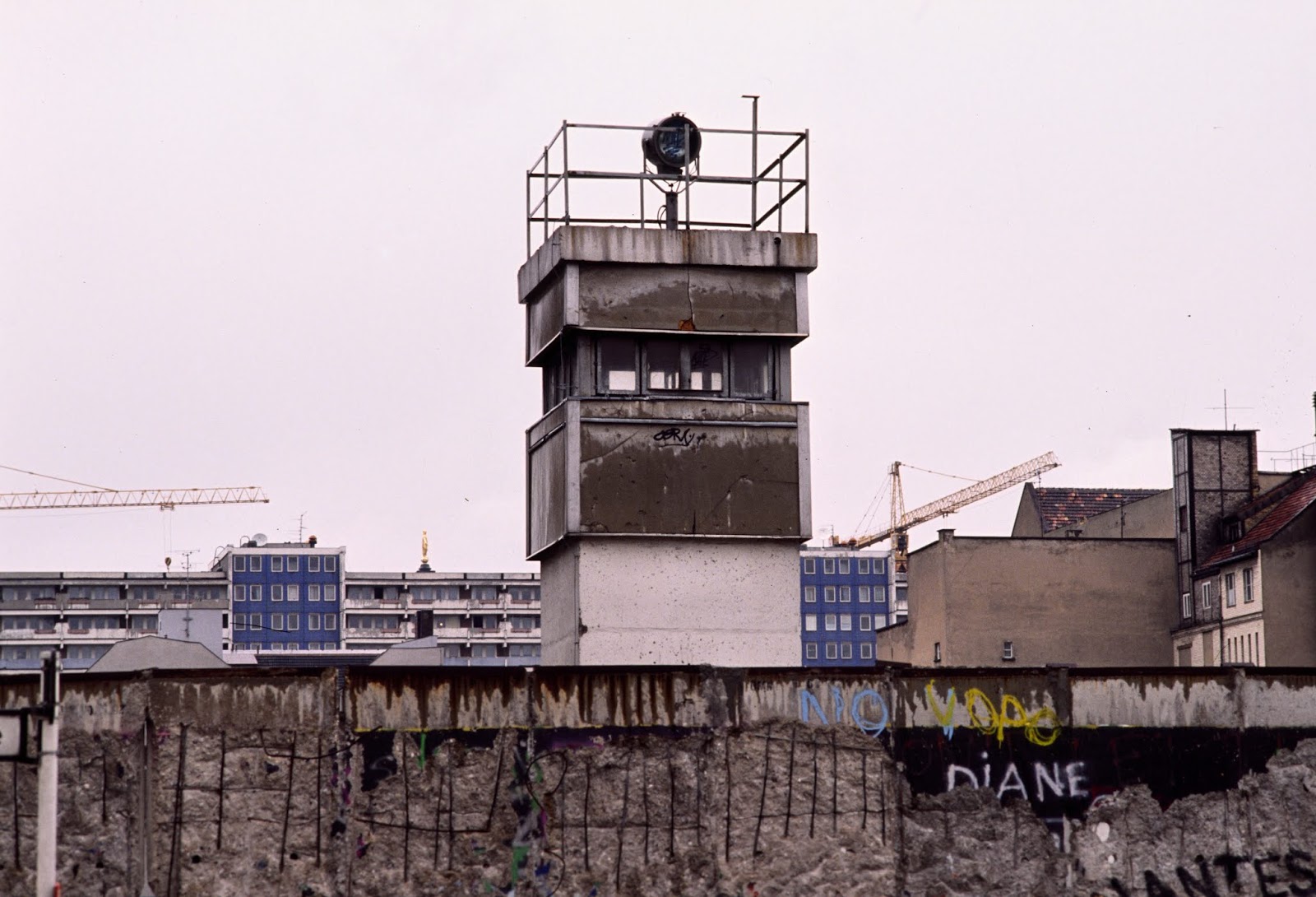
A now-empty East German guard tower
looms above the Berlin Wall.
 
As I've mentioned before, a long-running relationship with the World Missions Department of the Church of God took me to many countries and resulted in the production of more than 60 audio-visual programs to promote and raise funds for the Church's mission efforts.

In March, 1990, just four months after the opening of the Berlin Wall, the  World Missions Department, in conjunction with the Department of Youth and Christian Education, sent Louise and me on a three-week tour of Eastern European countries to gather photographs, video footage, and script information to create an audio-visual program to inspire the young people of the Church to raise money to print Bibles for distribution in the former Communist countries just emerging into freedom. This is the first in a series of posts about what we saw.
 
We began on March 8th with a tour of the plant in Frankfurt where Bibles were being printed in Eastern European languages. The next day, just four months after the Wall was breached, found us at the Brandenburg Gate, where throngs of East Berliners lined up to enter West Berlin.

East Germans file through the checkpoint
at the Brandenburg Gate.

We spent March 9th making photographs and shooting video of West Berlin street scenes and East Germans coming through the Brandenburg Gate and other checkpoints; and of people chipping away at the wall with hammers and chisels. (I still have a small bag of pieces of the wall.)

Climbing on the Wall near the Brandenburg Gate.
Chipping away at the Wall.
Hello, World!

I was working with my Olympus OM and Leica M cameras, while Louise was using an S-VHS video camera, a state-of-the-art semi-pro video rig at the time. Her load was heavier than mine, so I had to carry some of her equipment in addition to my own full camera bag. Louise, by the way, in addition to being beautiful, has a very good eye and feel for light. Better than mine, in fact. If she chose to be a serious photographer she could run circles around me.

March 9, 1990. The Rev. Billy Graham preaches
at the historic Gethsemane Evangelical Church.
A packed house of rapt listeners.

That evening we had the privilege of photographing a momentous occasion: the Rev. Billy Graham preaching to a packed house at East Berlin's Gethsemane Evangelical Church. East Germany, the birthplace of the Protestant Reformation, was once again fully open to the gospel.

Going from the sublime to the ridiculous, the next morning we boarded the dirtiest and shabbiest airplane we have ever seen, a Yugoslav Airlines two-motor job holding about 20 passengers, and were off to the country which at that time was known as Yugoslavia.

(All photographs were made on Fujichrome 100D film except for the last two, which were made on 3M 640T film pushed one stop to E.I. 1280.)

Photographs copyright 2021, David B.Jenkins

I post Monday, Wednesday, and Friday each week.

Soli Gloria Deo

For the glory of God alone

Tags: photography, Dave Jenkins, East Germany, East Berlin, West Berlin, Berlin Wall, Brandenburg Gate, Rev. Billy Graham, Olympus OM, Leica, Fujichrome 100D film, 3M 640T film, Yugoslavia, Yugoslav Airlines

March 10, 2021

Re-posting the Eastern Europe Series

A few of the many who lost their lives

attempting to escape Communism.


 Last week I wrote a post titled "History Repeats -- In Reverse," in which I referred to my trip in March of 1990 to document conditions in Eastern Europe as the Soviet Union began to lose its grip on the other Iron Curtain countries. I wrote about our adventures in a series of posts last March, the 30th anniversary of our trip, and have decided to re-post them because, as one reader commented, there is a need to preserve this history, since much of it is being rewritten in the name of "progress."

As the left in this country doubles down on its efforts to establish the same Marxist system from which thousands gave their lives in attempts to escape and millions gave their lives with no hope of escape, it's vital that those of us who remember those days bear witness to a generation that in the words of the song, "Don't know much about history. . ."

Some of my readers will not have read those posts; others may wish to read them again. If you've already read them and don't want to read them again, our regular programming will resume in April.

Photograph copyright 2021, David B.Jenkins

I post Monday, Wednesday, and Friday each week.

Soli Gloria Deo

For the glory of God alone

Photograph copyright 2021, David B.Jenkins

I post Monday, Wednesday, and Friday each week.

Soli Gloria Deo

For the glory of God alone