February 14, 2022

Photographic Composition 101 Part V: Simplify

Drummers at the Cultural Village, Lusaka, Zambia

Perhaps even more important than the other compositional principles we've looked at so far is simplicity. The comment that I hear perhaps more than any other about my pictures is that they are "clean." This means that they have no visual clutter in them.

For our photographs to have the sense of presence we want them to have, we must learn to simplify them. That means to make sure they have every element we want in the frame, and nothing that doesn't contribute to the overall effect. You are responsible for every square millimeter of that frame.

If you're not seeing what you want to see when you look through the viewfinder, move to a different position. Look from a higher or lower angle. Change lenses or zoom for a different focal length until you see the composition that sets forth the subject in the strongest way.

The picture of the Zambian drummers portrays the scene in the strongest way I could find. Even the fourth pair of hands in the lower right adds to the composition.

After Evening Chapel at the Mission Hospital, Abak, Ibom, Nigeria

Simplifying your pictures doesn't mean there can't be complexity. This photograph, made after evening chapel services at the mission hospital in Abak, Ibom Province, Nigeria, is one of the most complex photos I've ever made. Yet, it's also simple, because everything that needs to be in the frame is there and nothing that doesn't contribute to the whole.

Tribesman of Mayalan, Northern Guatemala

Likewise, this photograph of a tribesman in the remote mountain village of Mayalan in northern Guatemala tells us a great deal about him. We see his environment, the type of house he lives in, the distinctive tribal collar of his shirt. We also see something of his attitude in the way he stands and looks at the camera with a serious, somewhat challenging stare. Or maybe he's just thinking "What is that crazy gringo up to now?"

Everything in the frame tells us something about him and his life, and nothing detracts. That's what I mean by simplifying.

All photographs made with Olympus OM cameras, various lenses, and Fujichrome slide film.

Photographs and text copyright 1989-2022, David B.Jenkins.

I post Monday, Wednesday, and Friday each week unless life gets in the way.

Soli Gloria Deo

For the glory of God alone


February 11, 2022

Photographic Composition 101 Part IV: Leading Lines

 Lobster Shack, Cape Neddick, Maine

Just to be clear, leading lines in photography are not the same thing as the lines you once used to start a conversation with an attractive woman. In photography, as in painting, a leading line is something in the fore and usually middle ground of the picture that leads the eye to the main subject -- as in the photo of the lobster shack at Cape Neddick, Maine. Notice how the lines of the beached skiff and the pickup truck point to the shack?

This, by the way, is one of the few personal photos for which I used a 4x5 film camera. I used 4x5 a great deal in the studio, because, for much of my career it was the basic tool for commercial photography. However, a 4x5 camera is heavy and cumbersome, and the process of shooting with one is too slow for my impatient self! But I had taken it with me on this trip to Maine in 1984 and thought I might as well get some use from it. Calumet 4x5 view camera,210mm f5.6 Rodenstock lens,Kodak Ektachrome film.

Rainbow Springs Tobacco Barn, Cook County, Georgia

This tobacco barn with a Rainbow Springs sign is one of the best examples of leading lines in my photo files. In June, 1995 I was traveling through south Georgia on a quest for Rock City barns when I found it on US 41 just south of Sparks in Cook County. Since, in addition to Rock City barns I always photographed anything else of interest I found along the way, I naturally made a picture.

I could have walked up to the barn and filled the frame with it, but that photo would not have been nearly as interesting as one with the rows of plants, probably soybeans, leading up to it. Canon EOS A2, probably the EF 28-105 f3.5-4.5 lens, Fujichrome 100 slide film.

 Pemaquid Point Lighthouse, Cape Pemiquid, Maine

The line of the white picket fence draws the eye perfectly to the Pemaquid Point lighthouse at Cape Pemaquid, Maine. Leica M3, 50mm f2 Summicron lens, Kodachrome 64 slide film.

I want to emphasize that the things I've been writing about in the last few posts are compositional techniques, not rules. Using them can improve many photographs, but in some situations it may not be possibly to apply them, and some subjects do not need them. But before making a photo, I usually check to see if there is some way to put it in a frame, create a near-far relationship, or use leading lines. If not, I make the picture anyway. It may turn out just fine.

Photographs and text copyright 1984-2022, David B.Jenkins.

I post Monday, Wednesday, and Friday each week unless life gets in the way.

Soli Gloria Deo

For the glory of God alone


February 9, 2022

Photographic Composition 101 Part III: Near-Far Relationships

Clarence  Spindler, Gibson County, Indiana

I'm posting this series on photographic composition to help us remember to compose our pictures in ways that will give them the three-dimensional quality which helps communicate our thoughts and feelings most effectively. Most of us know this stuff, but I, at least, need an occasional reminder to use what I know.

In the previous two posts we talked about framing, which is an excellent way to create a three-dimensional effect in a photograph. However, there are many situations where an appropriate frame simply isn't available.

One alternate way to create that feeling of depth in a picture is by establishing a near/far relationship. In the photo above, Clarence Spindler and the kitten would have made a nice photo all by themselves. However, by setting Mr. Spindler and kitten in the foreground and his Rock City barn in the background, we create a visual relationship in which each element adds interest to the other. Canon EOS A2, 24mm f2.8 Zuiko lens. From my award-winning book Rock City Barns: A Passing Era.

Barn and Pond, Cherokee Valley Road, Catoosa County, Georgia

In this picture, the reeds occupy the foreground, the barn's reflection is in the middle distance, and finally, the barn, with its vivid, red color. (Lost my notes and don't remember which camera I used for this photograph.) This photo and the one below are from my limited-edition book Georgia: A Backroads Portrait.

Lookout Mountain from McLemore Cove, Walker County, Georgia

The bale of hay in the foreground and the bales scattered in the middle ground all direct the viewer's eye to Lookout Mountain, magnificent in its fall clothing. Pentax 6x7, 105mm f2.5 Takumar lens. All photographs with Fujichrome 100 film.

Photographs and text copyright 1996-2022, David B.Jenkins.

I post Monday, Wednesday, and Friday each week unless life gets in the way.

Soli Gloria Deo

For the glory of God alone


February 7, 2022

Photographic Composition 101 Part II: More about Framing

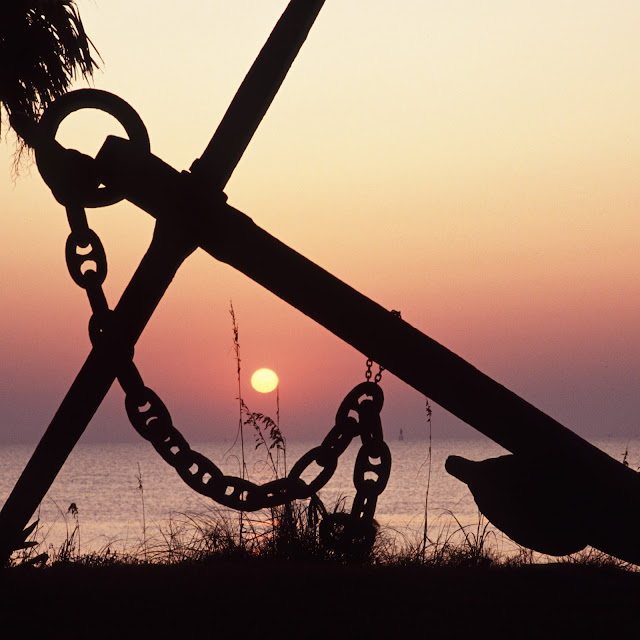
Sunrise on Tybee Island

Sometimes you can put the subject quite literally in a frame, as in this photograph of a sunrise on the beach at Tybee Island, Georgia, as seen through an old anchor just above the beach. Unfortunately, I don't remember what camera I used to make this picture, but it was probably an Olympus OM2n. The film was almost certainly Fujichrome 100, since that has been my film of choice since around 1986.

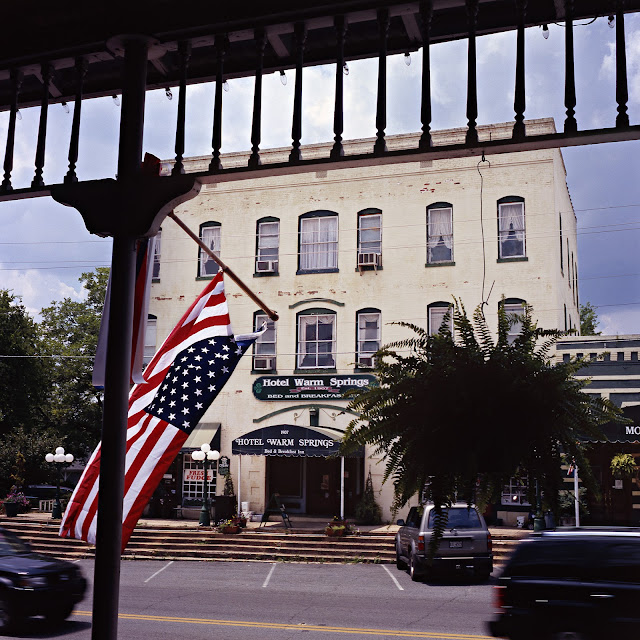
The Warm Springs Hotel, Warm Springs, Georgia

The frieze and column of a shop across the street form a frame for the old Warm Springs Hotel Bread and Breakfast, taken on my return trip to west Georgia in 2010 to complete my tour around the state. This photograph was made with one of my very favorite cameras -- a classic Minolta Autocord twin-lens reflex,  using Fujicrome 100 film in 2-14 X 2-1/4 size. I should use this camera more often! The two photos above are from my limited-edition book Georgia: A Backroads Portrait.

City Hall, Barnesville, Georgia

Surely the funkiest city hall in the entire United States!


Framing adds depth to a picture by drawing the eye to the main subject. Sometimes however, there are subjects that are so distinctive they can stand on their own. The unique City Hall in Barnesville, Georgia is what is, as it is, and needs nothing but a straight-on presentation. This photograph could not be improved by anything I could do to enhance it, whether by choosing a different angle or looking for something in the foreground to frame it. I love the way the street lamp reflects the curve of the arched windows. I used a Canon EOS 6D digital camera for this photo, with an EF 28-105mm f3.5-4.5 lens.

 Photographs and text copyright 1992-2022, David B.Jenkins.

I post Monday, Wednesday, and Friday each week unless life gets in the way.

Soli Gloria Deo

For the glory of God alone