May 9, 2025

W. L. Coker New River General Store, Tennessee Highway 116

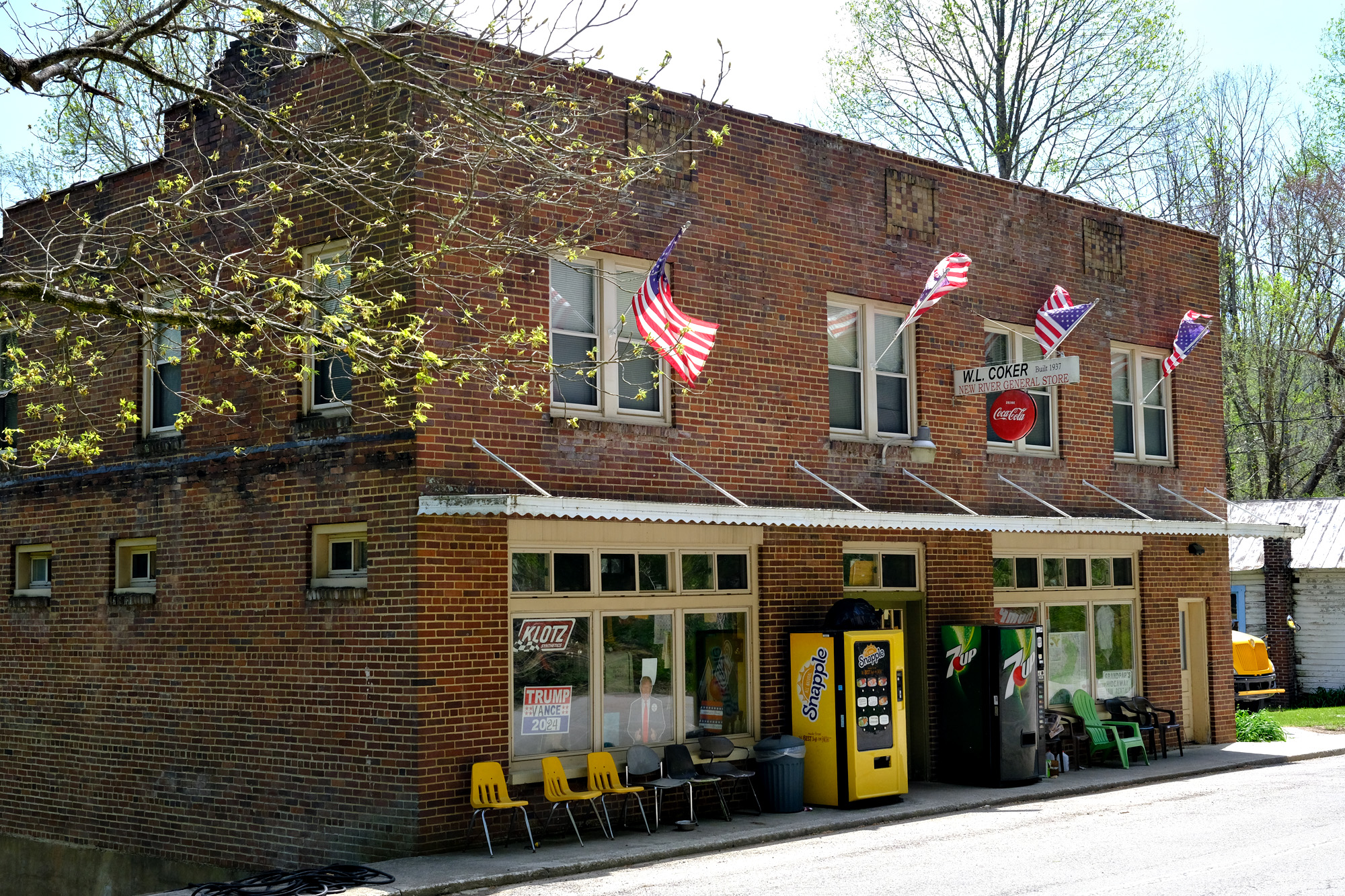
 W. L. Coker's New River General Store, TN Hwy. 116, Anderson County.

In 1937 (the year of my birth!) W.L Coker and his wife Belle built a two-story brick building on a remote stretch of gravel road in east Tennessee's mountainous Anderson County. The first floor was a general store, and the Cokers had living quarters on the second floor.

I can't imagine how the business survived, but there was a great deal of coal mining activity in the area in those day, so the store apparently did okay. It's still very much in business, now operated by a Coker grandson, although he does supplement his income by driving a school bus.

 The Blue & White Service Station next to Coker's Store.

The Blue & White Service Station, located beside the Coker store, is kinda dilapidated these days, but the pair of gas pumps between the two buildings are still very much in use.

That stretch of gravel road where the store is located is now paved and designated as Tennessee Highway 116, also known to some motorists as the Devil's Triangle because of the way the road winds around challenging curves and over steep mountains.

The Devil's Triangle is not as well-known as the Dragon, that stretch of U.S. Highway 129 between Maryville, Tennessee and Robbinsville, North Carolina, but I've driven them both and I believe the Triangle is even more challenging -- and dangerous, with sharp, winding curves, narrow shoulders, loose gravel and minimal guardrails. But of course, all that makes the road even more attractive to adventurous motorcyclists and sports car drivers.

Both photos were made with a Fuji X-T3 camera and the Fujinon 16-80mm f4 lens.

Visit my online gallery at https://davejenkins.pixels.com/  

Signed copies of my book Backroads and Byways of Georgia are available. The price is $22.95 plus $4.95 shipping. My PayPal address is djphoto@vol.com (which is also my email). Or you can mail a check to 8943 Wesley Place, Knoxville, TN 37922. Include your address and tell me how you would like your book inscribed.

Photography and text copyright 2025 David B.Jenkins.

I post Monday, Wednesday, and Friday unless life gets in the way.

Soli Gloria Deo -- For the glory of God alone.

Tags:   photography     digital photography     travel photography     east Tennessee      Fujinon XF 16-80mm lens     Fuji X-T3 camera     Tennessee Highway 116     Anderson County     Devil's Triangle     The Dragon     U.S. Highway 129

May 7, 2025

Photographers You Should Know: Fritz Henle; The Search for Beauty

White Sands, New Mexico
Utter simplicity, utter beauty.
 
"One thing an artist can do in this world is to remind people that there is so much beauty that you only have to see it." (Henle, The Search for Beauty)

Henle's daughter Tina says “My father’s three mantras were ‘beauty,’ ‘truth,’ and ‘freedom’. . . Those three words motivated my father’s life,”

Although he recognized that there is much ugliness in the world and he was not unrealistic about it, Henle felt that there were plenty of photographers who could cover that aspect of life. He believed, however, that there were also many good and beautiful things in life and his role was to make photographs that were life-affirming and positive.
 
 
Georges Braque, Cubist Painter
In my opinion one of the all-time great portraits.
 
"Probably the pictures that stand out strongest in your memory, from books, magazines, or exhibits, are those which struck a responsive chord in you -- reached across the distance to command your sympathy, curiosity, or understanding. This is photography's grandest achievement:: to reach what is most human in us. These are the documents that endure because they contain a human truth." (Henle, Photography for Everyone.)
 
"If you make photographs that are deeply felt and honestly seen, have faith in them and in yourself. . . (The photographer) may on occasion, record the ugly and document grief and pain. These are a part of the universe; but they are not all of it if we see life whole. . . A really great photographer is a searching and inquisitive eye. We see the world more clearly, more fully, mirrored in his pictures. The foundation of his vision is honesty. Its strength is his sympathy and understanding, and in his deep love for all of life." (Henle, Fritz Henle's Guide to Rollei Photography)
 
 
Chemist, Cities Service Company (now Citgo)
One of my favorite pictures and a great example of Henle's
framing and use of the three planes -- near, middle, and far.
A picture to study and learn from.

Very sadly indeed, the life-affirming photography that Henle did so beautifully has become passé in today's art world. The optimistic humanism reflected in his work has been greatly eroded in this post-modern era. There has been a crashing loss of faith in man. Instead of being seen as an heroic figure with unlimited potential for progress (the twin-lens reflex camera, by the way, was the perfect instrument for expressing this heroism because the viewpoint was usually one of looking up at the subject), he is now seen as a threat to the environment and a creature for which we can have, at best, only tentative hopes. Man has been deconstructed, and this is the reason nature, landscape, and environmental photography, although they have always been with us, have now come to the fore. The idea that "the proper study of man is man" has been largely abandoned.
 
As a Christian, I believe modernism and optimistic humanism to be flawed philosophies, but they nonetheless created a climate in which much of our greatest photography was produced. 
 
 
Caribbean Beauty
from his U.S. Virgin Islands portfolio.
 
Henle published many books in his lifetime, beginning with This Is Japan in 1937 and ending with Casals in 1975. Most of them are still available from sellers like amazon.com and abebooks.com. Prices vary widely. You might also check your local used book store if you're fortunate enough to have one.

In 1979 the Harry Ransom Center at the University of Texas began collecting Henle's photographs. He passed away in 1993 and the Center now has his entire archive. In 2009 the Center mounted a massive exhibit of his work and published a (also massive) book of his photographs titled Fritz Henle: In Search of Beauty with text by Roy Flukinger. This is the definitive volume about Henle's life and work, with hundreds of his photographs (although I'm sorry to say they left out some of my favorites.)
 

Caribbean Sunset
from his U.S. Virgin Islands portfolio.

Visit my online gallery at https://davejenkins.pixels.com/  

Signed copies of my book Backroads and Byways of Georgia are available. The price is $22.95 plus $4.95 shipping. My PayPal address is djphoto@vol.com (which is also my email). Or you can mail a check to 8943 Wesley Place, Knoxville, TN 37922. Include your address and tell me how you would like your book inscribed.

Photographs copyright 2025 Estate of Fritz Henle. Text copyright 2025 David B.Jenkins.

I post Monday, Wednesday, and Friday unless life gets in the way.

Soli Gloria Deo -- For the glory of God alone.

Tags:   photography      great photographers     Fritz Henle     Rolleiflex camera     twin-lens reflex camera     twin-lens reflex photography     Rolleiflex photography    Rollei     TLR
 

May 5, 2025

Photographers You Should Know: Fritz Henle; Tools and Techniques


 The Art Critic. Washington Square, New York City 1947.

Photography is about photographs.

In the preamble to this blog I said that I would talk about the tools, techniques, and philosophy of photography. Today, we're going to talk about tools and techniques, and a bit about the philosophy behind them.
 
Fritz Henle had a lot to say about the tools and techniques of photography— after all, he was well known as an advocate of a particular kind of tool, and wrote a number of books about how best to use it. But it all was in service to one particular goal: making photographs. He was a master of photographic technique, but he knew to use it, then forget about it. He had a "personal crusade. . . against deadly seriousness in technical matters, which kills the pleasure of photography." His pictures are about content, not technique, but the technique always reinforces the content. The purpose of technique is to enable the photographer to present the subject in accordance with his vision.

“. . . seeing pictures is always tied up with technique. I feel it is important to decide things like sharpness or unsharpness and not let them happen accidentally. It is equally important to command the techniques that get the effects you want.”


 Madame Niska, Fortune Teller. Paris, 1938.

Unlike digital cameras, which encourage you to blast away in hope of finding something worth keeping when you sort through your files, “The twin-lens encourages you, almost forces you, to think while shooting. . . There is no better eye-training than practicing to see pictures within that little square frame.”

Most photographers would find themselves feeling unbearably limited if confined to one type of camera, with only one lens of one focal length. Yet, that is the way Henle worked, and he covered an astonishing range of subject matter with astonishing results.

However, when the subject or circumstances demanded it, Henle was quite capable of using other tools. For instance, the Brooks-Plaubel Veriwide, about which he said "I have done a lot of work with the . . . Veriwide camera, an instrument that is guaranteed to stretch anyone's vision into wide horizontals."


 Stonehenge, with the Brooks-Plaubel Veriwide camera.

His photograph of Stonehenge, made with that camera, is the best I have every seen, perfectly capturing the mood and mystery of the ancient stones.

In 1966, when Rollei introduced their new 6x6cm (the same format as the Rollei TLR) single-lens reflex, the SL66, Henle began using it for much of his work, and began to work much more in color. He made many beautiful photographs with it, however in my opinion the years from the early 1930s, when he first began using the twin-lens reflex, through the mid-60s were the best, most productive years of his career, the years when he made most of his classic photographs.

Now that digital cameras make it easy for even the rankest amateur to produce sharp, well-exposed pictures by the hundreds and thousands, how is that so many of the greatest photographs in the history of the medium were made with cameras that we would consider primitive and discouragingly difficult to use? Could it be that those tools required their users to think about what they wanted to say with their photographs and to choose their techniques wisely to that end?


 Pablo Casals, 1972

 Perhaps we could learn something from Picasso, who said “Forcing yourself to use restricted means is the sort of restraint that liberates invention. It obliges you to make a kind of progress that you can’t even imagine in advance.” And from Orson Welles, who said “The enemy of art is the absence of limitations.”

Henle accepted the limitations he was given and used them to make his art.
 
To see more of Henle's pictures, visit the Henle Gallery. You might also enjoy this Youtube video.

Visit my online gallery at https://davejenkins.pixels.com/  

Signed copies of my book Backroads and Byways of Georgia are available. The price is $22.95 plus $4.95 shipping. My PayPal address is djphoto@vol.com (which is also my email). Or you can mail a check to 8943 Wesley Place, Knoxville, TN 37922. Include your address and tell me how you would like your book inscribed.

Photographs copyright 2025 Estate of Fritz Henle. Text copyright 2025 David B.Jenkins.

I post Monday, Wednesday, and Friday unless life gets in the way.

Soli Gloria Deo -- For the glory of God alone.

Tags:   photography      great photographers     Fritz Henle     Rolleiflex camera     twin-lens reflex camera     twin-lens reflex photography     Rolleiflex photography    Rollei     TLR     Rolleiflex SL66     Stonehenge     Pablo Casals     Brooks-Plaubel Veriwide camera

May 2, 2025

Photographers You Should Know: Fritz Henle, Mr. Rollei


 Nievis, Mexican model for many painters.

 Blog Note: After mentioning Fritz Henle and his book a New Guide to Rollei Photography in my previous post, I decided this would be a good time to repeat a series of posts about him from 2020.

Who was your first major influence in photography?

Mine was Fritz Henle, a German-born American who was considered one of the greatest photographers in the world in the 1930s through the '60s and even into the '70s. He was so identified with the Rolleiflex twin-lens reflex camera that he was known as "Mr. Rollei." Even though his TLR had only a fixed, 80mm focal-length lens, he took on an amazing range of assignments: magazine photography for clients such as Life and many, many others; fashion, travel, industrial, advertising, landscape, fine art, and more. He also produced 20 books of his photographs, beginning in 1937 with This Is Japan and culminating in 1975 with Casals.

My interest in photography began with the birth of my son Don in the summer of 1968 with a cheap Kodak Instamatic camera using 126 film cartridges. By spring of 1969 I had advanced to a cheap TLR, the Ricoh 66. (Notice the repetition of the word "cheap?" What can I say -- I was living on a private school  teacher's salary!) The Ricoh died before its time, but it had a sharp lens and negatives I made with it still print and scan well.


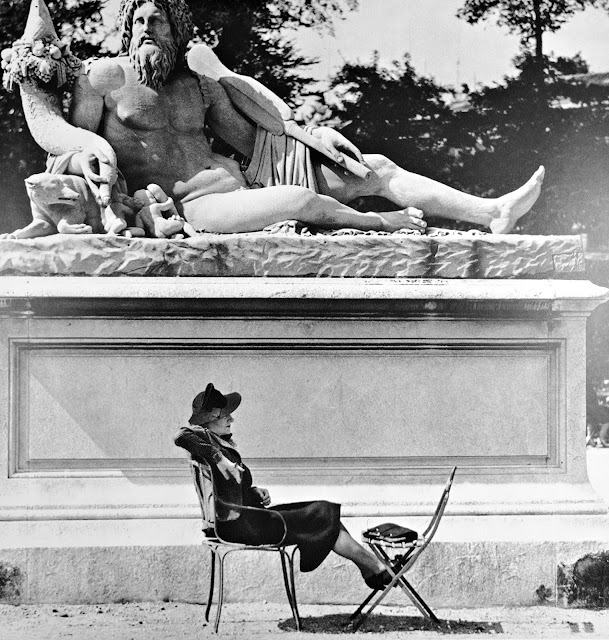
At the Louvre, Paris, 1938

 Speaking of scanning, during those early months of 1969 I was scanning the photography books section of the Miami Public Library when I came across a thin volume of photographs by Henle -- A New Guide to Rollei Photography, published by the Viking Press of New York in 1965. Leafing through the book, I nearly shouted for joy as many of the photographs touched me so deeply. For the first time I began to understand what photography can be.


 Texas Cowboys, 1956

Although I have most of Henle's books, including some rare and valuable ones, the New Guide to Rollei Photography is the one I return to again and again. Originally published as a compilation of monthly columns written for Popular Photography magazine in the late 1950s and early '60s, it is indeed a guide to photography with a twin-lens reflex, or any camera for that matter. Henle's simple but complex pictures are straightforward in technique (of which Henle was a master), yet display classic composition, of which he was also a master.

In fact, most of what I know about composition I learned from Henle's photographs. From him I learned to find ways to frame my point of interest, to use leading lines to emphasize the subject, and to balance near-far relationships. In fact, he sometimes used all three techniques in the same photograph. And he was a constant advocate of the square format, although he could depart from it when necessary.
 
 
 Net-Thrower, Hawaii, 1951
 
 "For years," he wrote, "I have waged a small private war in defense of the square format. . . What we learn from the twin-lens discipline is that values can be added to the picture by filling the square. We can think of the horizontal and vertical as squares to which something has been added at the sides or top and bottom."

Visit my online gallery at https://davejenkins.pixels.com/  

Signed copies of my book Backroads and Byways of Georgia are available. The price is $22.95 plus $4.95 shipping. My PayPal address is djphoto@vol.com (which is also my email). Or you can mail a check to 8943 Wesley Place, Knoxville, TN 37922. Include your address and tell me how you would like your book inscribed.

Photographs copyright 2025 Estate of Fritz Henle. Text copyright 2025 David B.Jenkins.

I post Monday, Wednesday, and Friday unless life gets in the way.

Soli Gloria Deo -- For the glory of God alone.

Tags:   photography     photography books      great photographers     Fritz Henle     Rolleiflex camera     twin-lens reflex camera     twin-lens reflex photography     Rolleiflex photography    Rollei     TLR