March 20, 2020

Eastern Europe 1990: Bucharest, Romania

In Bucharest, a woman places flowers at a street
memorial to those who were killed in the fighting.


Crossing the "Friendship" Bridge over the Danube on the morning of March 15, we were on our way north to Bucharest, Romania -- an easy, 60-mile drive past flat fields and farms. Upon arrival, we checked into the Hotel Nord (North), about which, more later.

Louise and I had a few hours on our own, so we hired a car and driver to take us around. Romania had just thrown off Communist rule and scenes of the battle were all around us.

One of the many buildings in Bucharest showing
the effects of the battles of December, 1989,

The regime of Nicolae Ceausescu was considered the most totalitarian and repressive in Eastern Europe. When protests broke out in Timisoara, little more than a month after the Berlin Wall was breached, he ordered his military to fire on the protestors, killing and wounding many. Massive rioting and fighting ensued. Ceausescu and his wife Elena attempted to flee in a helicopter, but were caught by the military, which had changed sides. They were tried and swiftly executed by a firing squad on December 25, 1989. The revolutionary forces then began the process of establishing a free Romania.

Romanian soldiers man a tank at one
of the national capitol buildings.

We photographed one of Ceausescu's palaces, other government buildings, some of them showing damage from shelling, and the pedestal from which Vladimir Lenin's statue had been removed in front of the very impressive national press building.

Another building badly damaged by the shelling.
I asked our guide "What does that graffiti mean?"
He replied, "It means We Got Them!"

That evening we were taken to a service at the Maranatha Church, which was packed with people, as has been every service we have attended on this tour.

When we returned to our room at the Hotel "North," we discovered how it had earned its name: the heat was turned off at night! We slept, not very comfortably, under a pile of blankets. The next morning, Louise ran hot water in the tub to see if she could warm the bathroom. We both ended up taking hot tub baths, which did chase away the chill!

Breakfast at the hotel restaurant was cold cuts and cheese and some of Paul Lauster's instant Nescafe, which he unfortunately left on the table. Then off to the Church's National Headquarters and Theological Seminary. The only Church of God school for Christian workers in all Eastern Europe, they were only allowed 15 students at a time by the Ceausescu regime.

A class at the Church of God School of Theology
in Bucharest. The only seminary in all of Eastern Europe.

A student at the Theological Seminary in Bucharest.

After lunch with the students, we we were taken on a tour of the Romanian capitol buildings, the Basilica of the Romanian Orthodox Patriarch, University Plaza, where Ceausescu's men fired on protesters on December 21 and 22, and the Palace Plaza, where Ceausescu attempted to speak to the crowds from a balcony and had to be rescued by helicopter.

The balcony of the Presidential Palace in Bucharest
from which the dictator Ceausescu attempted to address
the protesters. He had to be rescued by helicopter.
Sickened by having shed the blood of their own fellow-citizens,
the Romania army came over to the side of the people.

That evening, we went to a service at Philadelphia Church, a large building that again, was fully packed. Despite years of government opposition, the Church of God had by that time grown to 250,000 members.

Worshipers at one of the Bucharest churches.

Supper was at the hotel restaurant again, and then back to our room, where another hot bath before bed made for a less chilly night.

(Photographs made with Olympus OM and Leica M cameras and lenses, Fujichrome 100D and 400D films.) 

March 18, 2020

Eastern Europe 1990: More Bulgaria

Nineteenth-century Methodist missionaries planted
16 churches in Bulgaria, but by 1990 the church
in Shuman was one of only three remaining.

Blog Note: I apologize that this post did not appear at its usual time of 6 a.m.  We had an extended power outage last night.
 
After the previous day's mad, high-speed, 250-mile rush over second-grade roads interspersed with three church services, our third day in Bulgaria promised to be an easy one. We spent some time walking around the town of Shuman  before setting off for Ruse, about 70 miles away, a larger city on the Danube which would be our crossing point into Romania. One particular point of interest in Shuman was an old Methodist Church. Methodist missionaries came to this part of Bulgaria around 1860, and the church was built in 1895.

Bulgaria is mostly rural, with very fertile land. So much so, in fact, that before the coming of Communism it was known as "the garden of Europe." The Marxists tried to herd the people onto collective farms, and although they were successful in some places, many of the country people still lived in the ways of their ancestors.

Since we did not have a long distance to travel this day, we were able to take our time and stop whenever we saw something interesting to photograph.

Rural Life Along the Way to Ruse
 
A Bulgarian peasant woman spins wool into thread
the way her ancestors have done for a thousand years.
Three Bulgarian peasant farmers and their donkey cart.
A closer look at the friendly farmers. One seems a little skeptical.
A Bulgarian goat herder. He was looking at Louise, who
was video-taping him as I made this photograph.

Near the town of Razgrad, about halfway to Ruse, we visited the ruins  of the Roman city Abritus. In the fourth century A.D., the Emperor Constantine the Great fortified the town with walls 39 feet high and almost ten feet thick. It was destroyed in 586 A.D. Excavations on the site began in 1953. 

The Roman ruin of Abritus. The city's exterior walls
were 39 feet high and nearly 10 feet thick.

At Ruse, we checked into the Hotel Riga, where we had rooms on the 14th floor with a great view of the docks and shipyards on the Danube. Pavel took us for a walk around the town, where the people seemed freer and lighter in spirit than those in Sofia. 

The docks and shipyards on the Danube at Ruse.
 
The service that evening was held at one of the three Church of God churches in Ruse; a non-descript building about 60 feet long and 20 feet wide. It was packed with people.

Statue of Vladimir Lenin at Ruse

The next morning (March 15th) I was out early and walked to a statue of Lenin, about a mile away. Then after breakfast we were off to Romania. 

Like young people everywhere, these skateboarders are
unimpressed by the dignitaries of the past. (I was unable
to find the identify of this [probably] Communist leader.)

(Photographs made with Olympus OM and Leica M cameras and lenses, Fujichrome 100D and 400D films.)

March 16, 2020

Eastern Europe 1990: Bulgaria

Sofia, Bulgaria from our hotel balcony


Blog Note: I had hoped to make each of these posts correspond to the actual day in 1990, but as I said before, there is just too much to tell to limit each country to a single post; especially if we were there for several days.

We were met at the Sofia, Bulgaria airport on Monday, March 12 by Church of God National Overseer Pavel Ignatov and several of his associates, including Peter, his interpreter, and taken to the Park Hotel Moskva. Louise took the afternoon off to catch up on her rest and I hit the streets of Sofia with my cameras.

Downtown Sofia
A mix of the modern and the ancient.
Sofians enjoy a warm day in March.

That evening we were joined by the Rev. Paul Lauster from Berlin, the Eastern European Director for the Church of God, and taken to a mass rally in a rented movie theater -- the first time ever for all the Churches of God in Sofia to assemble in one place. It was standing room only, with packed balconies, stairs, and the lobby, with more standing outside. It was a joyous, enthusiastic group, estimated at 800-1000 people.

The all-city Church of God assembly.
The first in history for Bulgaria.
A worshipper at the rally.

After the rally we were taken to a nice restaurant on the mountain outside Sofia and entertained with live folk music by a foursome that featured a gypsy violinist.
 
Those Bulgarians fortunate enough to own cars keep their
windshield wipers locked inside except when it's raining.
Sometimes, though, the thieves even steal headlights.
The meat display shelves in Sofia's largest supermarket.
Under Socialism, everyone is equal. No one has anything.

We were in Sofia most of the next day, then set off in late afternoon for a church in a small town east of Sofia, arriving just before dark. After a 45-minute service, and with all kinds of food pushed into our hands by the hospitable villagers, we set off at high speed through the dark to another service at another small village church. Another brief service, then another high-speed drive to still another small church.

Pavel Ignatov and Paul Lauster pray over a young man
with cerebral palsy at one of the rural churches.

I should mention that we were traveling in a pair of Ladas, which were FIATS made in Russia under license from the Italians. One was driven by Pavel and the other by his brother. With four of us in each car we were fairly comfortable except for the fact that Pavel and Ronan drove at a steady 160 kph (that's about 100 miles per hour, if you don't know your metrics), over roads most of us would hesitate to tackle at half that speed. Not to mention that it was a very dark night.

Suddenly, Pavel slammed on the brakes. Being both a fatalist and a believer in the sovereignty of God (a potent combination!), I was asleep, so I missed the sight of the large wild boar who briefly challenged us for possession of the road. Fortunately, he thought better of it in time to save us all some bother.

After the third service of the evening there was another reckless, breathless, 60-mile ride to the city of Shumen, where we checked into a fairly new government hotel for the night.

(All photographs were made with Olympus OM and Leica M cameras and lenses, plus a 100-300mm f4 Tokina lens in Olympus mount. Films were Fujichrome 100D and 400D.)

March 13, 2020

Eastern Europe 1990: Yugoslavia

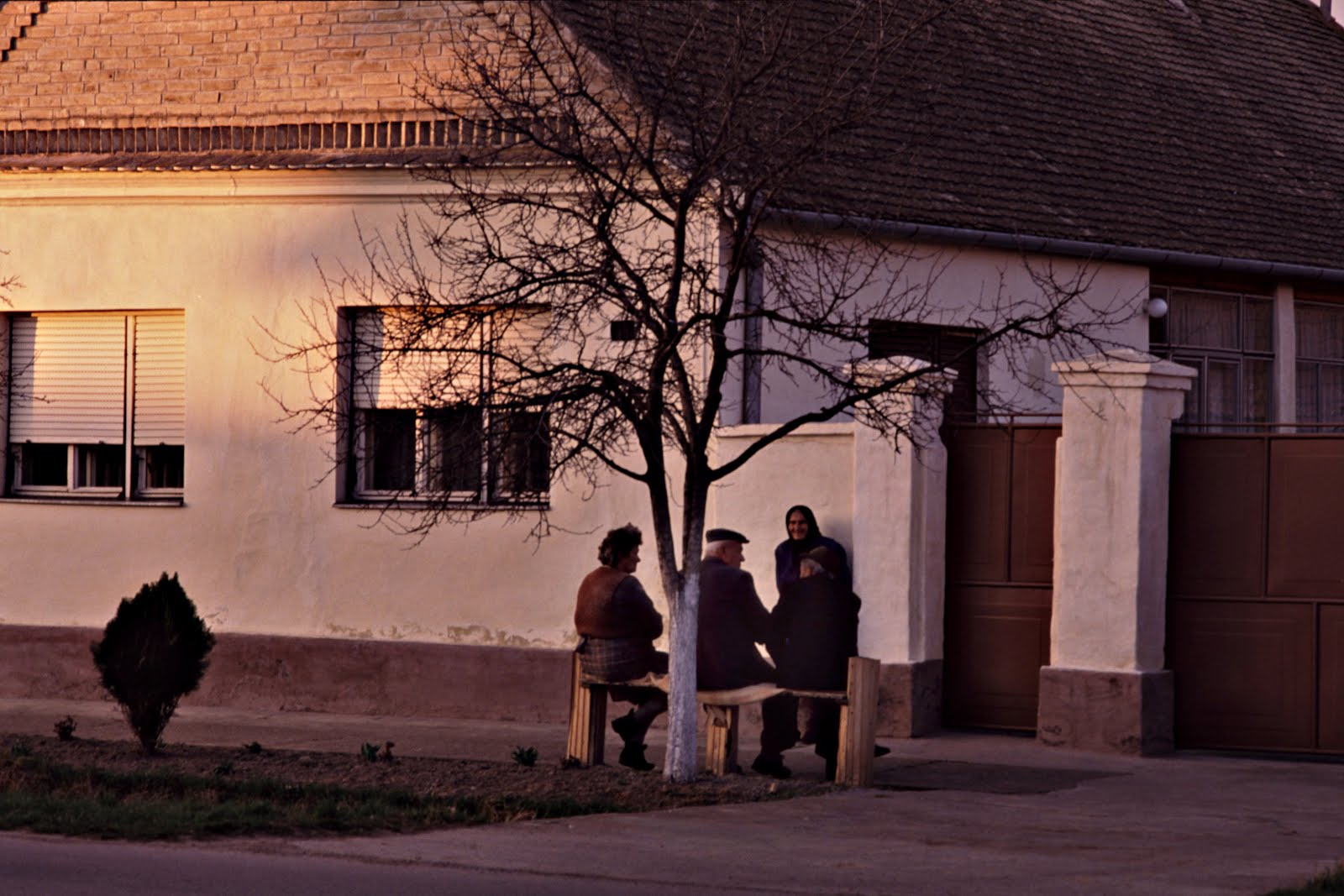
Villagers at Dalj on the Danube River
enjoy the evening light.


Surviving, somewhat to our surprise, the Flight of the Dirty Birdie (also known as a shabby and dirty Yugoslav Airlines two-engine propeller-driven puddle-jumper), we arrived from Berlin to Beograd in what is now Serbia on the morning of March 10, 1990 in need of a bath but otherwise little the worse for wear.

We were kept on the move for our two days in Yugoslavia; visiting churches in cities such as Sremska Mitrovica, now in Serbia, Vincovci, now in Croatia, and Dalj, a lovely village on the Danube River, also in Croatia. Yugoslavia was all one country in those days; now it has broken up into seven separate nations. It's a bit confusing to try to retrace our tour of 30 years ago, but Google Maps is our friend!

One of the small Church of God
congregations in Yugoslavia.

The Pentecostal movement, of which the Church of God is a part, came to Yugoslavia in 1925 when a Yugoslav man became an evangelical Christian while living in America. He returned to his home country and began starting independent Pentecostal churches. In 1968, one group of them united with the Church of God.

Under the repression of the Marxist government, the congregations remained small and struggling, numbering only 25 by 1990. Evangelical and Pentecostal churches in Communist countries struggled against unbelievable odds because they refused to be licensed by the government, which essentially would have meant allowing the government to run their churches. 

The Yugoslav believers are fervent in spirit.

Although the Berlin Wall was probably the most visible portion of the Iron Curtain within which the Marxist governments kept their peoples captured, their greatest effort was to build an even more impregnable wall around the minds of their captives: a wall to keep the Word of God out and the darkness in.

That's why Communism's greatest persecution has always been directed against religion. They have sought zealously to drive out the Word of God and replace it with the atheistic religion of Marxism.

Most of the Yugoslav Christians are
working people and not well-to-do.

On the surface, they were successful. By 1988, it is estimated there were only about 250,000 bibles in the entire Soviet Union. There were no Bible story books for the kids, no Sunday School literature, no schools to train young people for Christian service; in fact, in many of the Iron Curtain countries it was against the law to teach the Christian religion to children under 18.

Finding the promises of Communism to be empty,
many young people are turning to Christianity.

Conditions for Christians in Yugoslavia were not as bad as in some of the other Iron Curtain countries, because there was some limited religious liberty. Life was still a struggle for believers; yet in place after place as we traveled around the country we found small groups of fervent, enthusiastic believers who were not daunted by the odds against them. And everywhere we went we were welcomed with great  warmth and hospitality.

A barge on the Danube near Dalj.

(Photographs made with Olympus OM and Leica M cameras and lenses, Fujichrome 100D and 400D films.)